

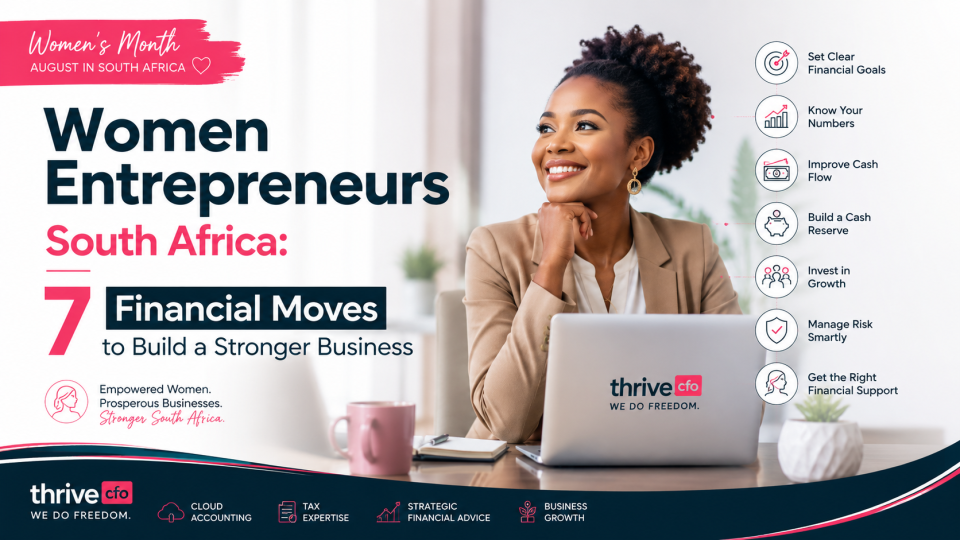
August is Women’s Month in South Africa, a fitting moment to talk not about obstacles, but about leverage. Women entrepreneurs South Africa-wide are starting and scaling businesses at pace, yet too many brilliant operators are held back by one fixable thing: the financial foundations underneath the business. Great products and loyal customers don’t survive weak cash flow, a tangled tax position, or funding you can’t access.
The good news is that financial strength is built from a handful of deliberate moves, not luck. This Women’s Month guide lays out seven practical financial power moves for women entrepreneurs South Africa can use to turn a good business into a resilient, fundable, scalable one, whatever sector you’re in.
Why the Financial Foundations Matter Most
A business rarely fails because the founder wasn’t talented. It fails because it ran out of cash, fell foul of SARS, or couldn’t raise capital at the moment it needed to grow. Women-owned businesses are a powerful and growing force in the South African economy, and the ones that endure are the ones that treat their finances as a core skill, not an afterthought to outsource and forget.
💡 ThriveCFO Tip: You don’t need to become an accountant. You need to understand your numbers well enough to make good decisions and ask sharp questions. Financial confidence, not financial perfection, is the goal.
7 Financial Power Moves for Women Entrepreneurs
1. Separate your business and personal finances, properly
The single most common foundation crack. Mixing personal and business money makes your real profitability invisible, complicates tax, and undermines any funding application. Open a dedicated business account, pay yourself a defined amount, and let the business stand on its own books. Our business banking comparison is a practical starting point.
2. Build a cash reserve before you need it
Cash is survival. A reserve covering even one to three months of running costs means a slow season, a late-paying client or a sudden cost doesn’t threaten the whole business. The discipline of building it is exactly what we cover in our cash flow management guide, and it’s the difference between weathering a shock and being sunk by one.
3. Know your numbers, and watch the right ones
You don’t need a hundred metrics. You need a few that matter: your gross margin, your monthly burn rate, your debtor days, and your runway. Reviewing these monthly turns you from reactive to strategic, and it’s what lets you spot trouble while it’s still small.
4. Get your tax structure right early
Sole proprietor, company, or something more layered? The structure you trade under affects your tax, your liability and your ability to raise money. Getting it right early, and understanding tools like the salary-versus-dividends decision for company owners, saves far more than it costs.
5. Access the funding that’s actually available to you
South Africa has a real ecosystem of funding aimed at women-owned and SME businesses, from development finance institutions and government-backed funds to private and enterprise-development programmes. The catch: they all want clean financials, a clear plan and proper compliance. The businesses that get funded are the ones whose books are ready before they apply.
6. Stay compliant, it’s a growth enabler, not just a cost
Tax compliance, CIPC annual returns and beneficial-ownership filings aren’t just box-ticking. A compliant business can bid for contracts, pass due diligence, and raise capital; a non-compliant one gets quietly excluded. Treat SARS compliance as part of being fundable, not a chore.
7. Plan for yourself, not just the business
Your business should build your wealth, not just its own. Pay yourself properly, contribute to retirement, and keep some growth outside the business so your financial future isn’t 100% tied to one venture. Founders who plan personally are the ones who can take smart risks in the business.
The quick-reference table
| Move | Why it matters | First step |
|---|---|---|
| Separate finances | Clarity, tax, fundability | Open a business account |
| Cash reserve | Survives shocks | Save 1 month of costs |
| Know your numbers | Strategic decisions | Track 4 key metrics monthly |
| Right tax structure | Tax + liability + funding | Get a structure review |
| Access funding | Fuel for growth | Get books application-ready |
| Stay compliant | Unlocks contracts & capital | Diarise key filings |
| Plan personally | Builds your wealth | Pay yourself + save |
A Worked Example: Thandi Turns the Corner
Thandi runs a growing catering business. Profitable on paper, she was constantly stressed about money, because personal and business funds ran through one account and she never knew her true position.
Three moves changed everything over six months:
| Move | Result |
|---|---|
| Opened a business account and paid herself a set salary | Saw her real margin for the first time, and it was healthier than she feared |
| Built a one-month cash reserve | Stopped panicking over slow-paying corporate clients |
| Cleaned up her tax and CIPC compliance | Qualified to bid for a recurring corporate catering contract |
None of it required more sales. It required treating the finances as seriously as the food. Within a year, Thandi was scaling deliberately instead of surviving month to month.
⚠️ Action point: Pick one of the seven moves and do it this month. Foundations are built one block at a time, and the first block, almost always, is separating your business and personal money.
Frequently Asked Questions
What financial mistakes do women entrepreneurs in South Africa most often make?
The most common is mixing personal and business finances, which hides true profitability and complicates tax and funding. Others include carrying no cash reserve, neglecting compliance, and not paying themselves a defined salary.
What funding is available for women-owned businesses in South Africa?
There’s a range of development finance, government-backed funds, and private and enterprise-development programmes aimed at women-owned and SME businesses. Most require clean financials, a clear business plan and up-to-date compliance, so prepare your books before applying.
How much should a small business keep in a cash reserve?
A practical target is one to three months of operating costs. Even a single month of reserve dramatically reduces the risk that a slow season or a late-paying client threatens the business.
Should I trade as a sole proprietor or a company?
It depends on your income, risk and growth plans. A company offers liability separation and funding advantages but adds compliance; a sole proprietorship is simpler but offers less protection. Get a structure review before you commit.
Why does compliance matter for growth?
Compliant businesses can bid for contracts, pass investor and customer due diligence, and raise capital. Non-compliance quietly disqualifies you from opportunities, so staying compliant is a growth enabler, not just a cost.
Build the Foundation, Then Scale
This Women’s Month, the most powerful thing women entrepreneurs South Africa-wide can do isn’t to work harder, it’s to build financial foundations strong enough to carry the growth they’re capable of. Separate your money, build a buffer, know your numbers, get compliant, and plan for yourself. Do that, and funding, contracts and scale stop being out of reach.
Want a partner who’ll help you build those foundations and read your numbers with you? Book a free discovery call with ThriveCFO, we work with founders who want to grow on solid ground.
This article is general information, not financial advice. Every business is different, speak to a qualified advisor about your specific situation.
Further reading and references
