


Starting and growing a small to medium-sized enterprise (SME) in South Africa comes with its unique set of challenges and opportunities. A critical foundation for any successful venture is robust business banking and an efficient payment gateway. This comprehensive guide provides a detailed SA business banking & payment gateway comparison for SMEs, helping you navigate the options from leading institutions like FNB, Absa, and Standard Bank, alongside popular local payment gateways such as PayFast and Yoco, highlighting their features, fees, and integration capabilities.
Why is the Right Business Banking & Payment Gateway Critical for Your SA SME?
For any South African SME, the choice of a business bank account and payment gateway is far more than just administrative; it’s a strategic decision that impacts everything from cash flow management and operational efficiency to customer satisfaction and overall profitability. Without the right financial tools, your business could face unnecessary fees, delayed transactions, complex reconciliation processes, and even lost sales. This SA Business Banking & Payment Gateway Comparison for SMEs aims to simplify this complex decision, offering clear insights into the top contenders.
✅ Key Takeaway: Choosing the right financial partners ensures smooth operations, optimises costs, and provides a seamless experience for both you and your customers. It’s an investment in your business’s future.
Decoding SA Business Banking: A Closer Look at Leading Institutions
South Africa’s banking landscape offers a variety of options tailored for SMEs. Here, we delve into the offerings of some of the country’s most prominent banks, focusing on features, fee structures, and suitability for different business needs.
FNB Business Accounts: What’s on Offer?
FNB (First National Bank) is a strong player in the SME market, offering a range of business accounts designed to cater to various stages of business growth. They are known for their digital banking capabilities and integrated solutions.
Key Features:
- Multiple Account Tiers: From entry-level accounts for micro-enterprises to more comprehensive solutions for established SMEs.
- Digital Tools: Strong online and mobile banking platforms, including invoicing and payroll features.
- Business Rewards: FNB’s eBucks programme extends to business accounts, offering rewards on spending.
- Integrated Payment Solutions: Often seamlessly integrates with their payment gateway, FNB Pay.
- Business Lending: Access to various financing options.
Potential Drawbacks:
- Fees can become complex depending on transaction volume and account tier.
- Requires active management to leverage all integrated tools.
FNB Business Account Comparison (Indicative)
| Feature | FNB Business Zero Account | FNB Enterprise Account | FNB Gold Business Account |
|---|---|---|---|
| Target Business | Sole proprietors, micro-businesses | Growing SMEs, higher transaction needs | Established SMEs, professional services |
| Monthly Fee | R0 (transaction fees apply) | Variable (often R100-R300+) | Variable (often R200-R500+) |
| Key Benefit | Cost-effective for low volume | Comprehensive digital tools | Dedicated relationship manager, higher limits |
| Transaction Fees | Pay-as-you-use, competitive | Bundle options, lower per-transaction | Bundle options, tailored rates |
| Digital Banking | Full access | Full access, advanced features | Full access, premium support |
| eBucks Rewards | Yes | Yes | Yes |
| Credit Facilities | Limited | Available | Extensive |
Absa Business Accounts: Powering Your Growth?
Absa provides a suite of business banking solutions focused on supporting growth and offering specialist advice. They often highlight their sector-specific expertise and comprehensive support for SMEs.
Key Features:
- Diverse Account Options: Catering to different business sizes and industries.
- Relationship Banking: Emphasis on dedicated business bankers and advisory services.
- Cash Flow Management Tools: Solutions for managing liquidity and working capital.
- Trade Finance: Support for businesses involved in international trade.
- Payment Solutions: Integration with Absa Payment Gateway.
Potential Drawbacks:
- Branch-based interactions might be more prevalent, though digital services are improving.
- Fee structures can be intricate, requiring careful review.
Absa Business Account Comparison (Indicative)
| Feature | Absa Startup Account | Absa Enterprise Account | Absa Platinum Business Account |
|---|---|---|---|
| Target Business | New businesses, informal traders | Growing businesses with turnover | Large SMEs, established corporations |
| Monthly Fee | R0 – R50 (transaction fees apply) | R100 – R400+ | R500+ |
| Key Benefit | Low cost for new ventures | Growth-focused tools, advice | Premium service, extensive facilities |
| Transaction Fees | Pay-as-you-use | Tiered pricing, bundles | Negotiated rates, comprehensive |
| Digital Banking | Standard | Enhanced | Advanced, dedicated support |
| Dedicated RM | No | Yes (for higher tiers) | Yes |
| Trade Finance | Limited | Available | Extensive |
Standard Bank Business Accounts: Stability and Innovation?
Standard Bank boasts a long-standing presence and a wide network, offering a blend of traditional banking stability with an increasing focus on digital innovation for SMEs.
Key Features:
- Extensive Branch Network: Broad physical presence across South Africa.
- Digital Platforms: Robust online and mobile banking, often with new digital tools.
- BizConnect Ecosystem: A platform offering various business tools and resources beyond banking.
- Industry-Specific Solutions: Tailored banking for sectors like agriculture, healthcare, and franchises.
- Payment Gateways: Integration with SnapScan and other payment solutions.
Potential Drawbacks:
- Digital user experience, while improving, can sometimes lag behind newer fintechs.
- Basic accounts may not offer competitive transaction fee bundles for high-volume businesses.
Standard Bank Business Account Comparison (Indicative)
| Feature | Standard Bank MyMo Business Account | Standard Bank Enterprise Direct | Standard Bank Business Current Account |
|---|---|---|---|
| Target Business | Small businesses, sole proprietors | Medium-sized businesses, digital focus | Larger SMEs, established entities |
| Monthly Fee | R5.50 | R80 – R250+ | R150 – R450+ |
| Key Benefit | Affordable, simple banking | Digital-first, flexible | Full-service, traditional banking |
| Transaction Fees | Pay-as-you-use, fixed fee for debit | Bundled options | Bundled options, negotiable |
| Digital Banking | MyMo App, Online Banking | Enhanced digital suite | Full suite |
| BizConnect Access | Basic | Full | Full |
| International Trade | Limited | Available | Extensive |
Other Contenders: Nedbank & Capitec Business
While FNB, Absa, and Standard Bank dominate, other players like Nedbank offer competitive business solutions, often excelling in niche areas or digital innovation. Capitec Business, a newer entrant, is rapidly gaining traction with its simplified fee structures and emphasis on digital-first banking, appealing particularly to micro and small businesses seeking transparency and affordability.
💡 Pro Tip: Always download the latest fee schedule directly from the bank’s website. These change frequently, and advertised rates may not reflect all charges relevant to your specific business activities.
Navigating SA Payment Gateways: Essential Tools for Online Sales
Once you’ve sorted your banking, the next crucial step, especially for any business trading online or needing flexible payment acceptance, is a reliable payment gateway. This section provides a focused SA Business Banking & Payment Gateway Comparison for SMEs, looking at the key players in the South African payment landscape.
PayFast: The Ubiquitous Choice for SA E-commerce?
PayFast is arguably the most widely recognised and used payment gateway in South Africa, particularly popular with e-commerce businesses.
Key Features:
- Wide Range of Payment Methods: Accepts credit/debit cards (Visa, Mastercard, Amex), Instant EFT (all major SA banks), Masterpass, Zapper, SnapScan, Mobicred, SCode.
- Easy Integration: Plugins for popular e-commerce platforms (WooCommerce, Shopify, Magento, etc.) and a robust API for custom solutions.
- Security: PCI DSS Level 1 compliant, 3D Secure enabled.
- Settlement: Daily or weekly payouts to your SA bank account.
- Recurring Payments: Supports subscriptions and recurring billing.
Fees (Indicative):
- Credit/Debit Cards: ~2.9% – 3.5% (excl. VAT) per transaction.
- Instant EFT: ~1.5% – 2.0% (excl. VAT) per transaction.
- No monthly fees or setup fees.
Suitability: Excellent for online stores of all sizes, from startups to established e-commerce players, due to its broad payment method support and ease of integration.
Yoco: Simplifying Payments for Offline and Online?
Yoco has revolutionised card payments for SMEs, particularly those with a physical presence, but also offers strong online solutions.
Key Features:
- Card Readers: Range of portable card machines (Go, Neo, Khumo) for in-person payments.
- Online Payments: Payment gateway for e-commerce, payment links, and invoicing via their app.
- Simple Pricing: No monthly fees, just transaction fees.
- Fast Payouts: Daily payouts to your bank account.
- Business Tools: In-app features for sales tracking, staff management, and reporting.
Fees (Indicative):
- Card Reader Cost: One-off purchase (e.g., Yoco Go ~R799, Khumo ~R2,499).
- Transaction Fees: Varies based on monthly sales volume, typically starting around 2.95% and decreasing with higher volume (e.g., down to 2.5% or lower).
- No monthly fees for the service itself.
Suitability: Ideal for businesses that require both in-person and online payment acceptance, such as retail stores, restaurants, service providers, and pop-up shops.
Ozow: Instant EFT and Beyond?
Ozow is a rapidly growing payment provider known for its Instant EFT solution, which allows customers to pay directly from their bank accounts quickly and securely.
Key Features:
- Instant EFT: Primary offering, enabling instant bank-to-bank transfers.
- Ozow PIN: Simplifies repeat payments for customers.
- Ozow ME: Direct payment links via QR codes or SMS.
- Debit Order Solutions: For recurring payments.
- Wide Bank Coverage: Supports all major South African banks.
- Integration: APIs and plugins for popular platforms.
Fees (Indicative):
- Instant EFT: ~1.5% – 2.0% (excl. VAT) per transaction.
- No monthly fees or setup fees.
Suitability: Highly effective for businesses where Instant EFT is a preferred payment method, particularly for high-value transactions or those wanting to minimise card processing fees. Also great for businesses needing quick payment verification.
Stitch & PayGate: Emerging Options & Enterprise Solutions?
Stitch is an API-first payments company offering robust payment initiation services, focusing on developers and larger platforms. They enable instant payments and data sharing. PayGate, a long-standing player, often caters to larger enterprises with more complex payment needs, offering a wide array of payment methods and fraud prevention tools. While both offer powerful solutions, their target market might lean towards more established or technically integrated businesses compared to the general SME market.
Key Factors to Consider When Choosing Your SA Business Banking & Payment Gateway
Making the right choice involves evaluating several critical factors against your unique business needs. This is where a focused SA Business Banking & Payment Gateway Comparison for SMEs truly pays off.
Fees & Charges: The Bottom Line
This is often the first consideration. Look beyond advertised monthly fees. Scrutinise:
- Monthly Account Fees: Some banks offer zero-monthly-fee options for startups.
- Transaction Fees: Per-transaction charges for deposits, withdrawals, electronic payments, card swipes. These can add up quickly.
- Interchange Fees (Payment Gateways): The percentage taken per card transaction.
- Settlement Fees: Are there charges for funds moving from your gateway to your bank?
- Hidden Costs: Look for fees on debit orders, failed payments, international transfers, or specific digital services.
Features & Functionality: What Do You Need?
- Digital Banking Experience: Is the online and mobile banking intuitive, feature-rich, and reliable?
- Reporting & Analytics: Does it offer clear insights into your finances and sales?
- Invoicing & Payroll: Integrated tools can save time and streamline operations.
- Credit & Lending: Access to overdrafts, business loans, or lines of credit.
- Payment Methods Accepted: Does the gateway support all the ways your customers want to pay?
- Point-of-Sale (POS) Integration: If you have a physical store, how well does the gateway integrate with your POS system?
Integration Capabilities: Seamless Operations
- Accounting Software: Can your bank account easily link with Xero, Sage, or QuickBooks?
- E-commerce Platforms: Does the payment gateway have plugins for Shopify, WooCommerce, etc.?
- API Access: For custom integrations, is the API well-documented and robust?
Customer Support: When Things Go Wrong
- Availability: Is support available when you need it (business hours, 24/7)?
- Channels: Phone, email, chat, dedicated relationship manager?
- Responsiveness & Expertise: Do they provide quick, helpful, and knowledgeable assistance?
Scalability: Growing with Your Business
- Can the accounts and gateways accommodate increased transaction volumes as your business grows?
- Are there higher-tier options or different pricing models that become more cost-effective at scale?
Security: Protecting Your Business & Customers
- Banking: Multi-factor authentication, fraud detection, regulatory compliance.
- Payment Gateway: PCI DSS compliance, 3D Secure, fraud monitoring, data encryption.
💡 Pro Tip: Create a spreadsheet comparing your top 2-3 banking and payment gateway choices side-by-side, detailing the specific features and costs relevant to your business model and projected transaction volumes. This focused SA Business Banking & Payment Gateway Comparison for SMEs will reveal the true cost.
Integrated Solutions: The Future of SA SME Finance?
The trend for SMEs is towards integrated financial ecosystems. Some banks are developing their own payment gateway solutions (like FNB Pay), while some payment providers are offering more banking-like features (like Yoco’s cash advance options). The ideal scenario for many SMEs is a seamless flow of funds and data between their banking and payment platforms, simplifying reconciliation and offering a holistic view of their financial health. Consider how well your chosen bank and gateway can communicate or if they are part of a larger, integrated offering.
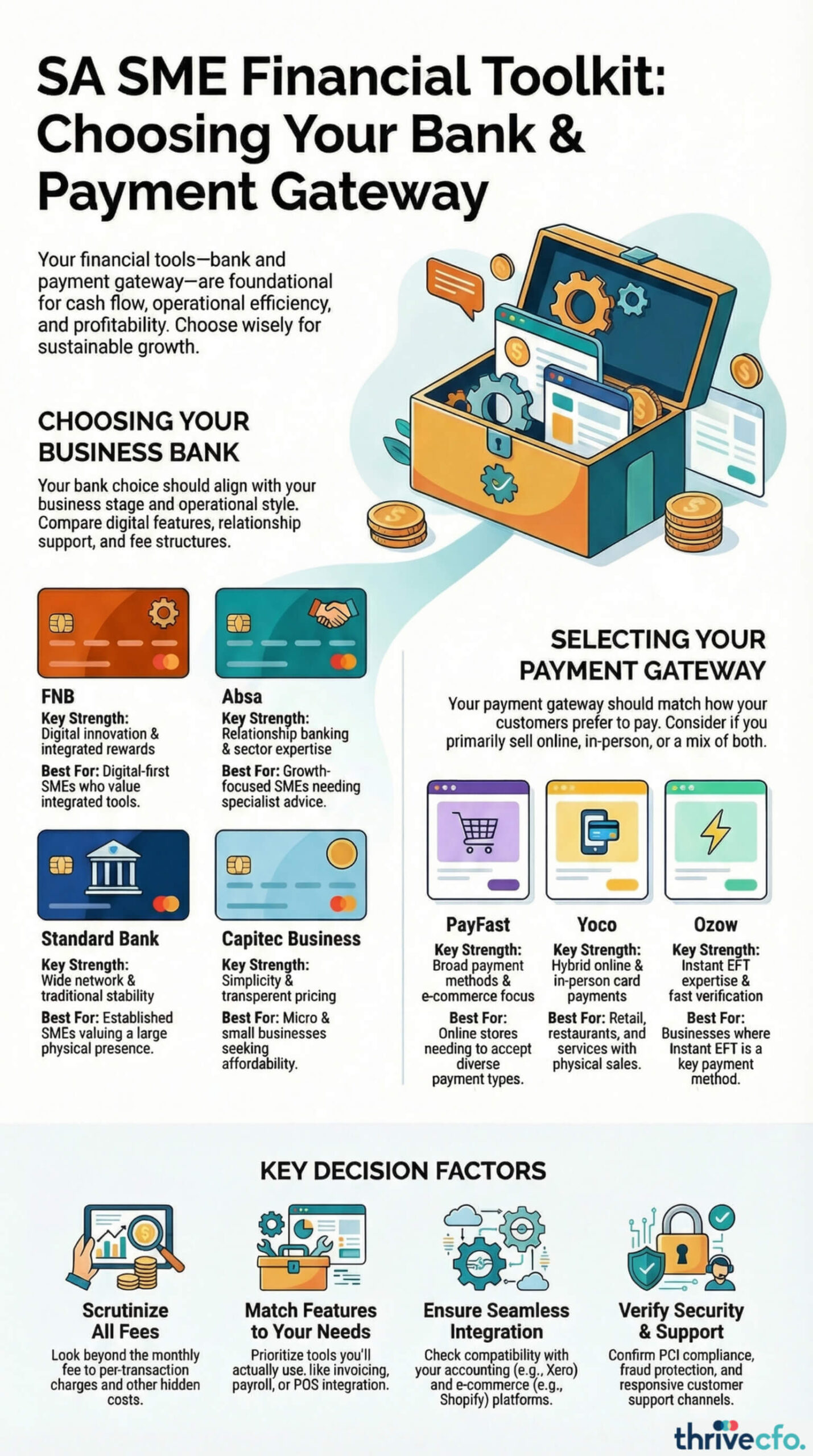
Comparative Overview: Business Banking & Payment Gateways for SA SMEs
Here’s a summary table to give you a quick comparative glance at the main offerings:
| Category | Provider | Key Strengths | Typical Fees (Indicative) | Best For |
|---|---|---|---|---|
| Business Banking | FNB | Digital innovation, integrated solutions | Variable monthly, transaction fees | Digital-first SMEs, those valuing rewards |
| Absa | Relationship banking, sector expertise | Variable monthly, transaction fees | Growth-focused SMEs, those needing advice | |
| Standard Bank | Wide network, stability, BizConnect ecosystem | Variable monthly, transaction fees | Established SMEs, those valuing traditional banking | |
| Capitec Business | Simplicity, transparent pricing | Low/zero monthly, competitive transaction | Micro & small businesses seeking affordability | |
| Payment Gateways | PayFast | Broad payment methods, e-commerce focus | ~2.9-3.5% card, ~1.5-2.0% EFT | Online stores, diverse payment needs |
| Yoco | Hybrid online/offline, simple pricing | ~2.5-2.95% card, device cost | Retail, services, businesses with physical sales | |
| Ozow | Instant EFT expertise, fast payment verification | ~1.5-2.0% EFT | Businesses prioritising Instant EFT, high-value sales |
Frequently Asked Questions
Q: Can I use a personal bank account for my SME? A: While possible for sole proprietors, it’s highly unadvisable. Separating personal and business finances is crucial for legal compliance, tax purposes, and clearly understanding your business’s financial health. Most formal payment gateways also require a dedicated business account for payouts.
Q: How long does it take for funds to reflect from a payment gateway? A: This varies by gateway. PayFast and Yoco typically offer daily payouts, meaning funds are transferred to your linked business bank account the next business day after the transaction. Ozow’s Instant EFT reflects in your account almost immediately. Always confirm the settlement times directly with your chosen provider.
Q: Do I need multiple payment gateways? A: Generally, one comprehensive payment gateway is sufficient for most SMEs. However, some businesses might opt for a primary gateway for cards and a secondary one specifically for Instant EFT if they find it offers better rates or features for that specific payment type. It often adds complexity, so evaluate the benefits carefully.
Choosing the right business banking partner and payment gateway is a pivotal decision for any South African SME. By carefully conducting your own SA Business Banking & Payment Gateway Comparison for SMEs, scrutinising fees, features, and support, you can establish a robust financial infrastructure that supports your business’s growth and ensures seamless operations for years to come. Take the time to research thoroughly, compare options based on your specific needs, and don’t hesitate to contact the providers directly for tailored advice. Your business deserves the best financial foundation to thrive.
