


You’ve navigated the lean years, survived the cash-flow crunches, and finally, your business is showing a healthy profit. But as you look at the bottom line, a familiar face appears at the table: the “silent partner” who takes a cut without ever lifting a finger. In South Africa, that partner is SARS, and the 2025 Budget has made their seat at your table significantly more expensive.
With personal income tax brackets frozen, a phenomenon known as “fiscal drag” set to climb, the way you extract money from your company is no longer just an accounting detail; it is a critical survival strategy.
Most directors default to a standard monthly salary out of habit, but the 2025/2026 tax landscape has fundamentally shifted the math. This post distills the most counter-intuitive takeaways from the latest regulations, moving beyond the “salary-only” mindset to explore how a strategic, blended approach to remuneration can protect your wealth from a silent raid on your margins.
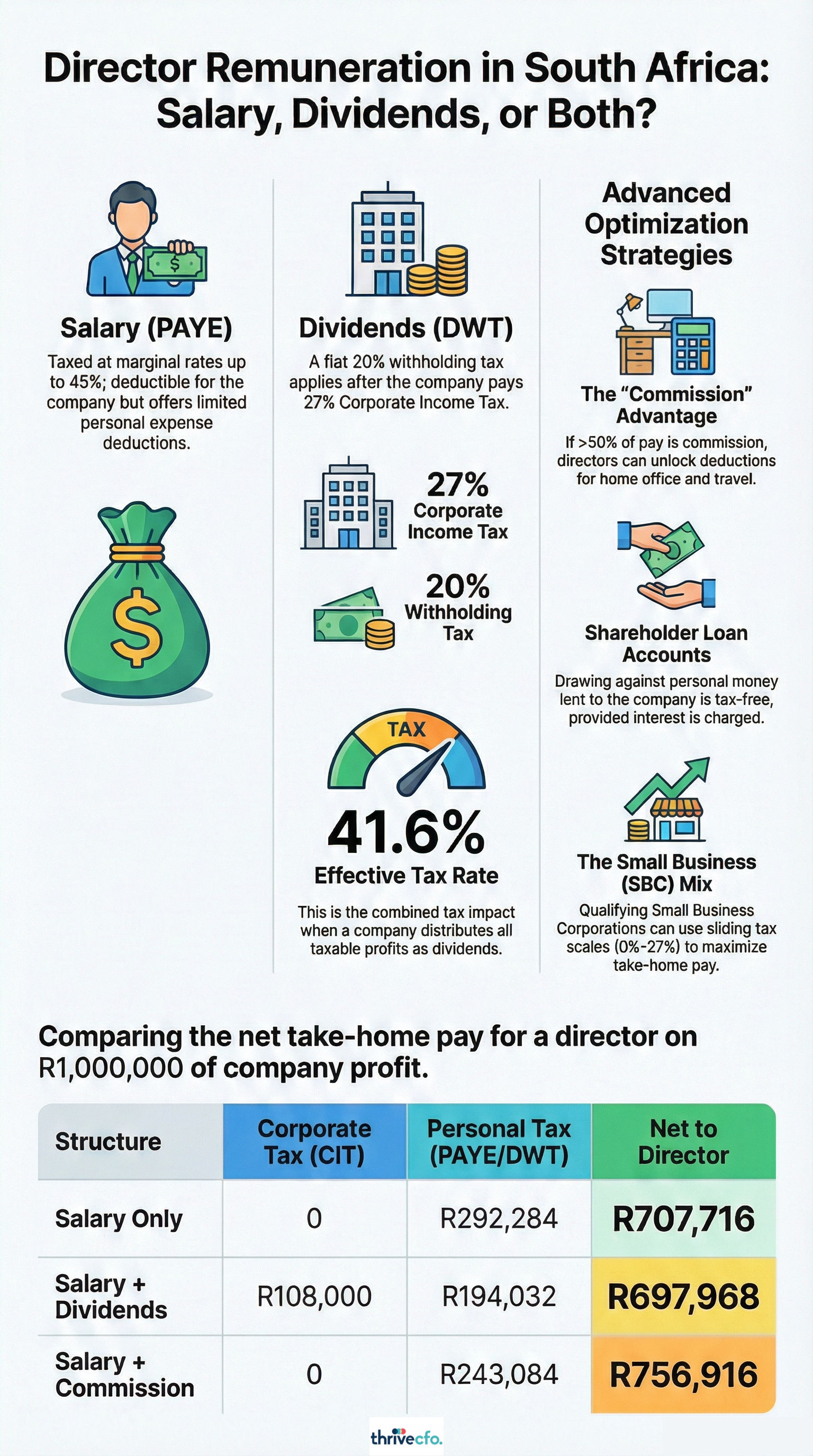
1. The Dividend Trap: Why the 41.6% Effective Tax Rate Matters
There is a pervasive myth in South African boardrooms that dividends are the “cheaper” way to get paid because the Dividends Withholding Tax (DWT) is a flat 20%, whereas personal income tax hits 45% at the top end. This is a half-truth that often leads directors into a “dividend trap.”
To understand the real cost, you must look at the effective tax rate. Because dividends are paid from post-tax profits, the company first pays 27% Corporate Income Tax (CIT) on its earnings. Only then is the remaining 73% distributed, where it is hit with another 20% DWT. When you combine these layers, the math is sobering: for every R100 in profit, the tax man takes R27 in CIT and R14.60 in DWT, leaving you with just R58.40. That is an effective tax rate of 41.6%.
Scenario: Extracting R1,000,000 in Profit
| Pay Structure | Total Tax Paid | Net Take-Home | Effective Tax Rate |
|---|---|---|---|
| Salary Only | R292,284 (PAYE) | R707,716 | 29.2% |
| Dividends Only | R416,000 (CIT + DWT) | R584,000 | 41.6% |
| Commission Mix (Scenario B)* | R243,084 (PAYE) | R756,916 | 24.3% |
*Note: The Commission Mix assumes a base salary of R400k plus R600k commission with R120k in valid deductions.
2. Section 23(m): How South African Directors Can Claim Business Deductions
If you are the primary “rainmaker” for your business, you may be overlooking the strategic power of Section 23(m) of the Income Tax Act. Standard salaried employees are strictly barred from deducting home office expenses, travel, or client entertainment. However, if you structure your remuneration so that more than 50% of your income is derived from commission or performance-linked pay, you transition from “employee” to “commission earner” in the eyes of SARS.
The “So What?”
By shifting more than half your pay to commission, you can turn personal costs into business deductions. “If you legitimately qualify as a commission earner, you may deduct: Home office costs… Travel expenses… Client entertainment… and Professional fees.”
However, this strategy requires iron-clad documentation. The commission must be genuinely tied to measurable outcomes, like revenue generated or contracts signed, to survive a SARS audit under the General Anti-Avoidance Rules.
3. Leveraging Shareholder Loan Accounts and Interest Exemptions
The most tax-efficient way to extract money is often to simply take back what you already gave. If you personally funded startup costs or left previous salaries in the business, you have a credit balance in your loan account. Drawing down on this is a capital repayment and is completely tax-free.
However, once you start borrowing from the company, the loan account becomes a double-edged sword. To avoid being hit with a “deemed dividend” tax of 20%, you must follow the Rules of Engagement:
- The Interest Mandate: The company must charge you interest at the SARS official rate (currently 8.5% as of February 2025).
- The Strategist’s Edge (Interest Exemption): While the interest you pay the company is income in your personal capacity, a seasoned strategist knows that natural persons under 65 enjoy an annual interest exemption of R23,800. This allows for a significant “sweet spot” where you can utilise company cash virtually tax-free.
- The Repayment Deadline: To avoid the 20% deemed dividend penalty, credit balances must be repaid or interest must be charged at the official rate by the end of the year of assessment.
4. Small Business Corporation (SBC) Tax Brackets for 2025/2026
If your company qualifies as a Small Business Corporation (SBC), the “hybrid” approach (Salary + Dividends) becomes your most potent weapon. Because the SBC scale starts at 0%, a clever director can essentially “double-dip” into tax-free zones.
By taking a salary up to the personal tax threshold (R95,750) and keeping the remaining first R95,750 of profit in the company, you “zero out” the tax on nearly R200,000 of income. This efficiency is why an SBC mix can save over R69,000 in total tax compared to a standard company dividend structure on a R1.7m profit.
2025/2026 SBC Strategic Brackets:
- R0 – R95,750 0% (The “Zero Zone”)
- R95,751 – R365,000 7% of amount above R95,750
- R365,001 – R550,000 R18,848 + 21% of amount above R365,000
- R550,001 and above R57,698 + 27% of amount above R550,000
5. The “Silent” 2025 Budget Hit: Fiscal Drag and VAT Hikes
The 2025 Budget Speech executed a “stealth tax” on the middle class by what it didn’t say. By failing to adjust personal income tax brackets for inflation, fiscal drag, the government is effectively taxing more of your “real” income as your nominal salary rises to keep up with costs.
This silent raid is compounded by a two-stage VAT hike. The rate will climb to 15.5% in May 2025 and to 16% in April 2026. This isn’t just a corporate problem; it increases your personal “cost of living” for every luxury and necessity you buy. In an environment where the government is squeezing both ends of the pipe, tax efficiency is no longer optional, it’s the only way to maintain your purchasing power.
Conclusion: Strategy Over Tradition
The era of the “one-size-fits-all” salary is dead. The 2025/2026 landscape demands a blended approach:
- Base Salary: High enough to utilise primary rebates and maximise the 27.5% retirement contribution deduction.
- Commission Structure: To unlock Section 23(m) deductions for your home office and travel.
- Loan Account Management: To access capital tax-free while utilising the R23,800 interest exemption.
- Dividends: Reserved for surplus profits once your marginal PAYE rate exceeds the 41.6% effective dividend hit.
In a year of rising VAT and static tax brackets, the question remains: are you paying yourself out of habit, or out of strategy?
