

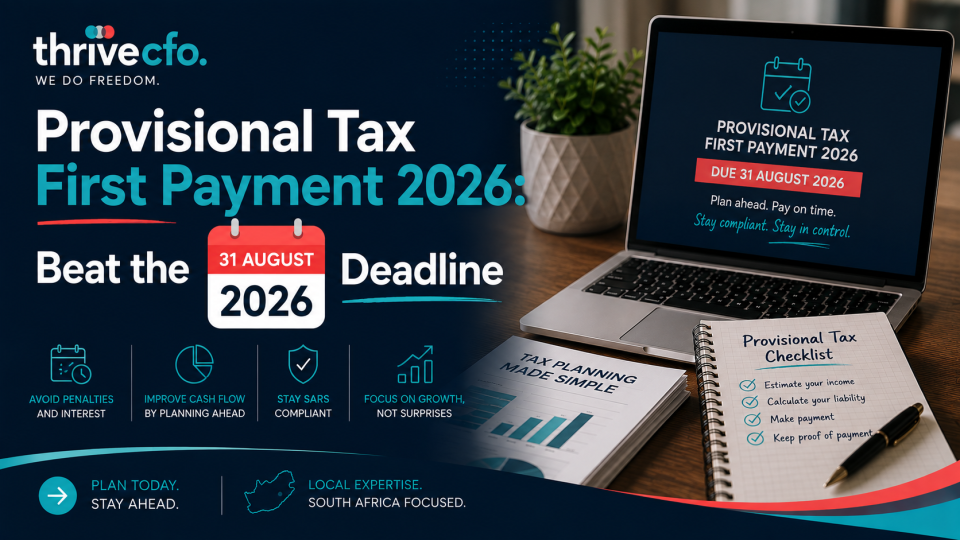
If you earn income that isn’t taxed through a payroll, business profits, rental, freelance fees, director’s earnings, SARS expects you to pay tax in advance, twice a year. The first of those instalments, the provisional tax first payment for the 2027 tax year, is due on 31 August 2026. Miss it, or lowball your estimate, and SARS adds penalties and interest that turn a cash-flow inconvenience into a genuine expense.
This isn’t the same as your annual return. Provisional tax is a forecast, you estimate what you’ll earn for the full year and pay tax on half of it now. Get the estimate right and it’s painless. Get it wrong and the penalties bite. Here’s exactly how the provisional tax first payment works in 2026, how to estimate it, and how to avoid every penalty SARS can throw at you.
Who Has to Make a Provisional Tax First Payment?
You’re a provisional taxpayer if you earn income that doesn’t have PAYE deducted at source. That typically includes:
- Sole proprietors and freelancers earning business income
- Company directors and shareholders drawing income beyond a regular salary
- Landlords earning rental income
- Anyone with significant investment, interest or other non-salary income above the thresholds
If that’s you, the 31 August 2026 first-period deadline applies. (Salaried employees with only an IRP5 generally aren’t provisional taxpayers, but the moment you add a side business or rental, you may become one. Our auto-assessment guide explains why business owners shouldn’t rely on a simple assessment.)
💡 ThriveCFO Tip: Provisional tax doesn’t add to your total tax bill, it just spreads the payment across the year so you’re not hit with one enormous amount in 2027. Think of it as paying as you earn, the way salaried staff already do.
The 2026 Provisional Tax Deadlines
For the 2027 year of assessment (which began 1 March 2026):
| Period | What it covers | Deadline |
|---|---|---|
| First payment | Half your estimated annual tax | 31 August 2026 |
| Second payment | Balance to your full estimate | 28 February 2027 |
| Third (voluntary) “top-up” | Optional, to limit interest | 30 September 2027 |
The provisional tax first payment is the one staring you down right now. It’s submitted on an IRP6 return via eFiling.
How to Calculate Your First Payment
The first-period calculation is straightforward once you have your estimate:
- Estimate your total taxable income for the full 2027 year.
- Calculate the tax on that estimate using the 2027 tax tables, and subtract rebates.
- Subtract any employees’ tax (PAYE) already withheld and allowable foreign tax credits.
- Divide the result by two, that’s your first payment.
A worked example: Sipho’s first payment
Sipho runs a consultancy and expects R600,000 in taxable income for the 2027 year.
| Step | Amount |
|---|---|
| Estimated taxable income | R600,000 |
| Tax per the 2027 tables (before rebates) | ~R151,000 |
| Less primary rebate | (~R17,235) |
| Annual tax payable | ~R133,765 |
| First payment (÷ 2) | ~R66,880 |
So Sipho pays roughly R66,880 by 31 August 2026, with the balance due in February. If he simply forgets, SARS adds a 10% late-payment penalty, about R6,688 for missing a deadline he could have diarised.
⚠️ Action point: Don’t wait until 31 August to discover your numbers. Pull your year-to-date management accounts in July, project the full year, and calculate the payment with time to arrange the cash. Scrambling on deadline day is how penalties happen.
The Penalties You’re Trying to Avoid
SARS has three ways to make underpayment expensive:
- Late-payment penalty (10%), pay the provisional tax first payment even one day late and SARS levies 10% of the amount due. This one is pure, avoidable waste.
- Underestimation penalty (20%), mainly a second-period risk, but it matters: if your final estimate is too low, SARS charges 20% of the shortfall.
- Interest (section 89quat), interest accrues on underpaid tax until it’s settled.
For the underestimation penalty, the safe-harbour rules are:
| Taxable income | Your estimate must be at least |
|---|---|
| Below R1 million | 90% of actual or the “basic amount” from your last assessment |
| Above R1 million | 80% of actual taxable income |
💡 ThriveCFO Tip: Note a 2026 change, with effect from 25 February 2026, failing to pay the estimated amount on time can also expose you to the underestimation penalty, not just the 10% late-payment penalty. The cost of a late or lowball estimate has gone up. Don’t treat the first payment as optional.
The “Basic Amount” Safety Net
If you’re unsure how to estimate a volatile income, the basic amount is your friend. It’s the taxable income from your most recent assessment (with adjustments if that assessment is more than 18 months old). For taxpayers under R1 million, using the basic amount as your estimate generally protects you from the underestimation penalty, even if you ultimately earn more.
That said, the basic amount is a floor, not a strategy. If you know your income has jumped this year, estimate honestly. Deliberately anchoring to an old, low basic amount when you’ve had a bumper year invites scrutiny and a second-period shortfall.
Make Provisional Tax a Process, Not a Panic
The taxpayers who never pay provisional-tax penalties treat it as routine:
- Diarise 31 August and 28 February every year.
- Keep management accounts current so your estimate is grounded in real numbers, not guesses.
- Set aside the cash monthly so the payment doesn’t wreck your cash flow, the same discipline as our cash flow management guide.
- Review your estimate at the second period and use the voluntary third payment to mop up interest if needed.
For the deeper mechanics, our full provisional tax planning guide walks through the calculations and edge cases.
Frequently Asked Questions
When is the provisional tax first payment due in 2026?
For the 2027 tax year, the first provisional tax payment is due on 31 August 2026, submitted on an IRP6 return via eFiling.
How do I calculate my first provisional tax payment?
Estimate your full-year taxable income, calculate the tax using the 2027 tables, subtract rebates and any PAYE already paid, then divide by two. That half is your first payment.
What happens if I pay my provisional tax late?
SARS levies a 10% late-payment penalty on the amount due, and from 25 February 2026 a late or unpaid estimate can also trigger the 20% underestimation penalty, plus interest.
What is the “basic amount” in provisional tax?
It’s the taxable income from your most recent assessment, used as a default estimate. For taxpayers under R1 million, estimating at least the basic amount generally protects you from the underestimation penalty.
Do I have to pay provisional tax if I also have a salary?
If your non-salary income (business, rental, freelance, significant investment income) exceeds the thresholds, yes, even if you also earn a salary with PAYE deducted. The PAYE already paid is credited against your calculation.
Don’t Hand SARS 10% for Nothing
The provisional tax first payment due 31 August 2026 is one of the most avoidable penalties in the tax calendar. Estimate honestly, file your IRP6 on time, and set the cash aside in advance, and it’s simply tax you were always going to pay, spread sensibly across the year.
Not sure what to estimate, or whether you’re even a provisional taxpayer? Book a free discovery call with ThriveCFO and we’ll calculate your first payment, register you correctly, and keep you penalty-free.
This article is general information, not tax advice. Provisional tax is fact-specific, consult a registered tax practitioner before filing.
Further reading and references
