

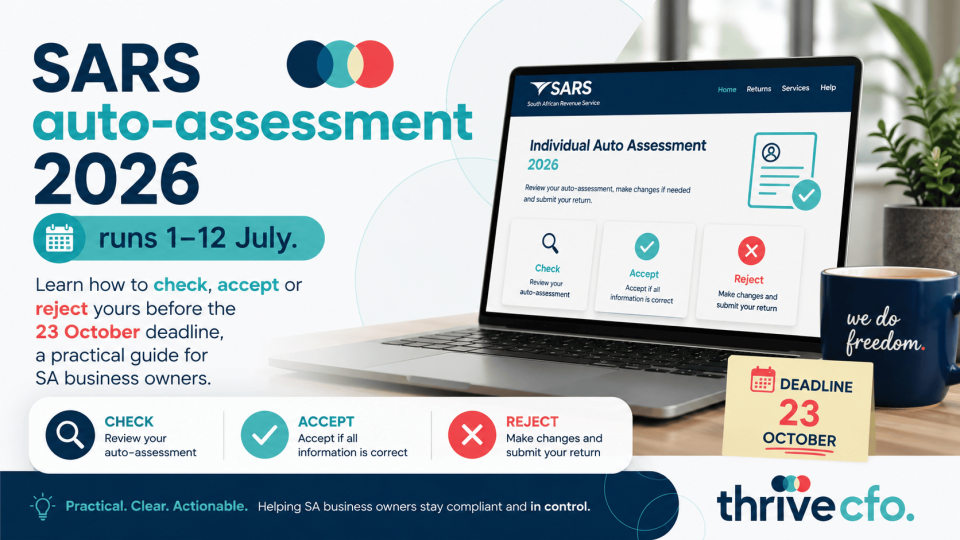
Between 1 and 12 July 2026, SARS will quietly issue roughly 6 million auto-assessments by SMS and email, and a lot of South African business owners are going to accept theirs without reading the fine print. That is exactly how a “free” refund turns into an audit two years later. The SARS auto-assessment 2026 process is faster and slicker than ever, but speed is not the same as accuracy, and for anyone running a business, the gaps are usually expensive ones.
This guide is written for the owner-manager, the director and the side-hustler, not the salaried employee with one IRP5 and nothing else. If you earn rental income, draw director’s dividends, trade crypto, or run a registered company, your tax picture is more complex than the third-party data SARS holds. Here is how to handle your SARS auto-assessment 2026 without getting burned.
What the SARS Auto-Assessment 2026 Actually Is
An auto-assessment is SARS pre-filling your tax return using third-party data, IRP5s from employers, IT3(b) and IT3(c) certificates from banks and investment houses, medical aid contributions, and retirement annuity data. If their numbers say you owe nothing extra or are due a refund, they send you an assessment and treat it as final unless you act.
Here are the dates that matter this year:
| Phase | Dates | Who it affects |
|---|---|---|
| Auto-assessment notifications | 1 – 12 July 2026 | ~6 million taxpayers with “simple” affairs |
| Refund payout (if due) | Within 72 hours of acceptance | Auto-assessed taxpayers, banking details verified |
| General filing season | 13 July – 23 October 2026 | Non-provisional taxpayers who must file |
| Provisional taxpayer deadline | 22 January 2027 | Most business owners and directors |
💡 ThriveCFO Tip: If you do not receive an SMS or email by 12 July 2026, you have not been auto-assessed. Do not sit and wait for one, you fall into the normal filing season and the clock is still ticking toward 23 October.
The mechanism is convenient. The risk is that SARS only knows what third parties told them. Anything they don’t see, and a business generates a lot they don’t see, is your responsibility to add.
Why Business Owners Should Never Just Click “Accept”
A salaried employee with one income source and a medical aid can often accept an auto-assessment safely. A business owner usually cannot. SARS does not automatically know about:
- Rental income from a property you let out
- Director’s dividends and the related dividends tax position
- Crypto-asset gains, newly visible to SARS under the crypto reporting crackdown but not always reflected in your auto-assessment
- Home-office, travel and other deductions you are legitimately entitled to claim
- Foreign income or offshore investment returns
- Trade income from a sole proprietorship or side business
When SARS leaves these out and you accept, you have effectively under-declared, and the penalty for that lands on you, not on SARS. Equally, when SARS leaves out a deduction you were entitled to, accepting means you have voluntarily overpaid.
A worked example: the R18,000 mistake
Sipho runs a small consultancy as a sole proprietor and also earns a salary from a part-time lecturing post. In July 2026 he receives an auto-assessment showing a R6,200 refund based purely on his IRP5 and medical aid. Delighted, he is about to accept.
What the auto-assessment ignores: Sipho earned R240,000 in consulting fees that year, against which he can claim R74,000 in legitimate expenses (home office, data, professional subscriptions, accounting fees). His consulting profit of R166,000 pushes him into a higher marginal band and means he actually owes tax, but it also means he is a provisional taxpayer who should never have been auto-assessed as “simple” in the first place.
| Scenario | Outcome |
|---|---|
| Accept the auto-assessment as-is | R6,200 “refund” now, under-declared trade income, future audit + penalties up to 200% |
| File correctly as a provisional taxpayer | Declare R166,000 profit, claim R74,000 expenses, pay the correct amount, sleep at night |
The “refund” Sipho nearly accepted would have cost him roughly R18,000 in back-tax, penalties and interest down the line. Accepting was the expensive option.
⚠️ Action point: If you are registered for provisional tax, treat any auto-assessment with deep suspicion. You almost certainly have income SARS hasn’t seen. Read our provisional tax planning guide before you do anything.
How to Check Your SARS Auto-Assessment 2026 in 15 Minutes
Do not accept or reject on your phone in the car park. Log into eFiling or the SARS MobiApp and work through this checklist properly.
- Open the assessment (ITA34) and read the income sources listed.
- Cross-check every IRP5 and IT3 certificate against your own records. Missing one? It must be added.
- List income SARS did not include, rental, trade, crypto, foreign, dividends.
- List deductions SARS did not include, home office, retirement annuity top-ups, donations (s18A), medical out-of-pocket.
- Check your banking details are current, or any refund will bounce.
- Confirm your provisional taxpayer status, if you are one, you file a full return regardless.
If everything SARS has is complete and there is nothing to add, you can accept. If anything is missing, in either direction, you edit and file instead.
💡 ThriveCFO Tip: SARS has introduced a “Waiting Room” limited-functionality page for the July rush. If eFiling is sluggish in the first week, that is the traffic-management system doing its job, not an error. Try again outside peak hours rather than refiling repeatedly.
Accept, Edit or Reject: Making the Call
You have three paths once you’ve reviewed your SARS auto-assessment 2026:
- Accept, only when the assessment is genuinely complete and correct. Refunds typically pay within 72 hours.
- Edit and file, when income or deductions are missing. You change the return and submit it as your own. This is the route most business owners take.
- Do nothing, dangerous. If you ignore an auto-assessment that is wrong in SARS’s favour, you may keep an incorrect refund and create a future liability. If it’s wrong in your favour and you do nothing, SARS’s version becomes final and you overpay.
The deadline to make changes to an auto-assessment aligns with the 23 October 2026 non-provisional deadline, but provisional taxpayers work to their own 22 January 2027 date. Don’t gamble on the later date, the longer you wait, the colder your records get.
The Penalty Maths Nobody Talks About
Under-declaration is not treated as an innocent oversight. SARS can levy understatement penalties ranging from 10% to 200% of the shortfall depending on behaviour, plus interest that compounds monthly. Accepting a convenient auto-assessment that omits your rental or trade income is, in SARS’s eyes, a declaration that it was complete.
Compare the two outcomes for a business owner who omits R120,000 of rental income taxed at a 31% marginal rate:
| Item | Amount |
|---|---|
| Tax actually due on the omission | ~R37,200 |
| Understatement penalty (say 50%) | ~R18,600 |
| Interest (illustrative, 12 months) | ~R4,000 |
| Total exposure | ~R59,800 |
All of that to avoid 15 minutes of checking in July. The auto-assessment is a convenience SARS offers itself, your job is to make sure it tells the truth.
Frequently Asked Questions
Do I have to accept my SARS auto-assessment 2026?
No. An auto-assessment is SARS’s proposal, not a final instruction. You can edit and file your own return if income or deductions are missing, right up to your filing deadline.
I’m a business owner, why was I auto-assessed at all?
SARS auto-assesses based on the third-party data it holds. If your employer and bank reported “simple” data, you may be flagged even though your full affairs are complex. Being auto-assessed does not relieve you of the duty to declare all income.
What happens if I ignore the auto-assessment?
SARS’s version becomes your final assessment after the filing deadline. If it under-states your income you carry the future liability; if it over-states your tax you simply overpay. Either way, doing nothing is rarely the right move for a business owner.
When will I get my refund?
If you accept an auto-assessment showing a refund and your banking details are verified, SARS aims to pay within 72 hours. Refunds can be held if you have outstanding returns or a verification is triggered.
I trade crypto on the side, is that in my auto-assessment?
Often not yet, but SARS’s visibility is increasing sharply under the new Crypto-Asset Reporting Framework. Declaring crypto gains is your responsibility even when they don’t appear in the pre-filled return.
Don’t Let a 72-Hour Refund Cost You a Two-Year Audit
The SARS auto-assessment 2026 is built for speed, and for millions of South Africans with a single salary it works beautifully. For business owners, directors and anyone with income SARS can’t see, it’s a trap dressed as a convenience. Fifteen minutes of checking in July protects you from years of penalties and interest.
If you’re not sure whether your auto-assessment is complete, or whether you should be filing as a provisional taxpayer at all, book a free discovery call with ThriveCFO. We’ll model your specific numbers before you click a single button.
This article is general information, not tax advice. Your circumstances are unique, speak to a registered tax practitioner before acting.
Further reading and references
