


Provisional tax planning is the proactive management of your income tax liability throughout the year, crucial for South African individuals and companies who earn income beyond a standard salary. This strategic approach ensures you pay your income tax in installments, preventing a large, unexpected tax bill and potential penalties from the South African Revenue Service (SARS) at year-end.
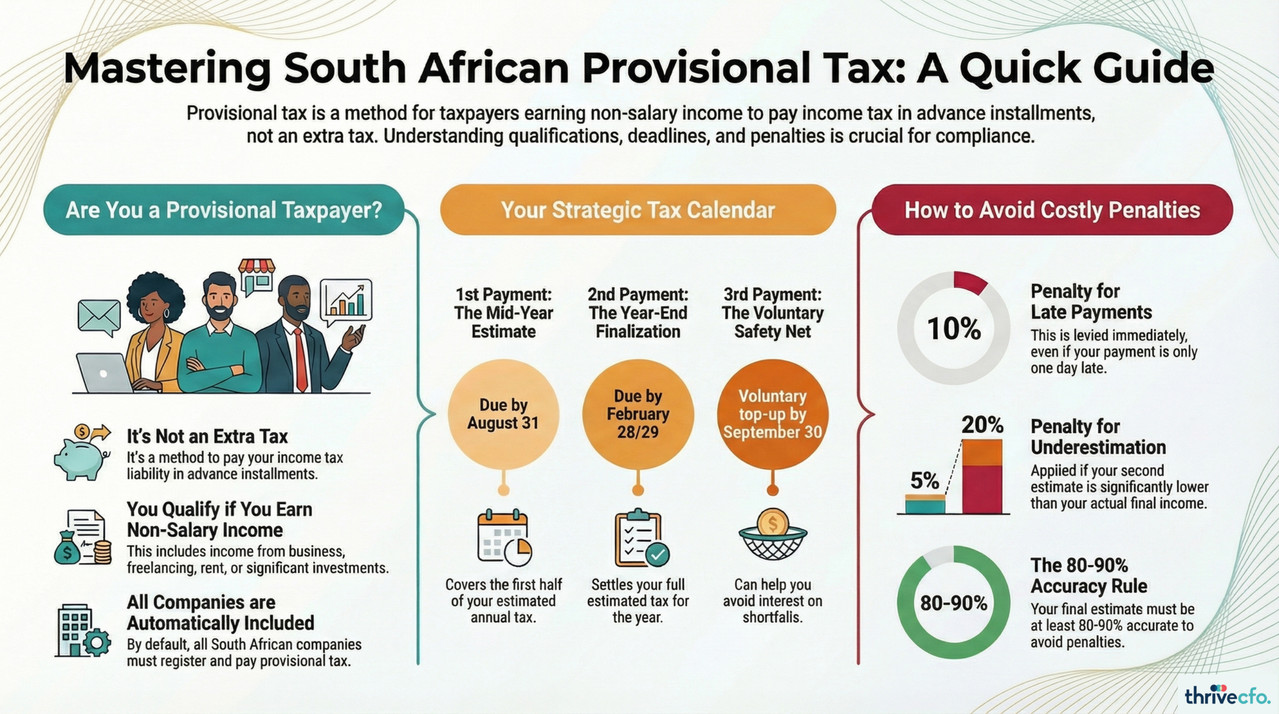
1. Demystifying Provisional Tax: It Is Not a Separate Tax
The single most common misconception is that provisional tax is an extra tax. It isn’t. It’s simply a method of paying your existing income tax in advance, spread across the year instead of landing as one large bill – much like a monthly subscription versus an annual lump sum.
For salaried employees, this happens automatically through PAYE: your employer deducts tax each month and pays SARS on your behalf. If you earn income that isn’t run through a payroll — business profits, freelance fees, rental or investment income – there’s no employer doing that for you, so SARS uses the provisional tax system instead.
The practical difference is who’s in the driver’s seat. PAYE is employer-driven and automatic; provisional tax is taxpayer-driven, meaning you estimate your annual income and make the advance payments. Both feed the same final income tax bill – provisional tax just asks more of you in planning and discipline.
💡 Tip: Think of provisional tax as building your own PAYE system. That mindset naturally pushes you toward saving as you earn and estimating carefully.
2. Who Qualifies? Confirming Your Status as a Provisional Taxpayer
Determining if you are a provisional taxpayer is the first critical step in effective provisional tax planning. The onus is on you to identify your provisional taxpayer status and register if necessary.
Income Thresholds for Individuals and Freelancers
You are generally a provisional taxpayer if you earn income other than remuneration, or if your remuneration is from an employer not registered for Employees’ Tax (e.g., certain foreign employers). This includes individuals who derive income from:
- Business or freelance activities.
- Rental income from property.
- Interest and investment income exceeding R30,000 per year.
- Other taxable income not subject to PAYE.
For the 2025 tax year, if you are under 65, you qualify as a provisional taxpayer if your total taxable income exceeds R95,750 and includes non-salary income above R30,000. For those aged 65 to 74, the threshold is R148,217, and for 75 and older, it’s R165,689.
Rules for Companies and Trusts
All companies in South Africa are provisional taxpayers by default, regardless of their income sources. Trusts also fall under the provisional tax system.
Exemptions for Over-65s and Low-Income Earners
Certain individuals are exempt from provisional tax. These typically include natural persons whose taxable income is below the tax threshold and who do not earn income from a business. Additionally, individuals whose passive taxable income (interest, dividends, and rentals) does not exceed R30,000 are often exempt, provided they do not derive income from carrying on a business and their taxable income is below the tax threshold.
✅ Key Takeaway: Don’t assume you’re exempt. Review your income streams annually to confirm your provisional taxpayer status, especially if your financial situation changes.
3. The Strategic Calendar: Critical Deadlines for the Tax Year
Provisional tax adherence revolves around strict deadlines. Missing these can lead to penalties and interest.
| Payment Period | Deadline (for February year-end) | Basis of Calculation |
|---|---|---|
| Period 1 | August 31 (or last business day) | Half of estimated annual tax |
| Period 2 | February 28/29 (last business day) | Total estimated annual tax (less previous payments) |
| Period 3 | September 30 (voluntary top-up) | Adjust for actual final liability |
Note: For the 2026 tax year, the first payment is due by August 31, 2025, and the second by February 28, 2026.
Period 1: The August Deadline
The first provisional tax payment is due within six months of the start of the assessment year, which is typically August 31 for individuals and companies with a February year-end. This payment covers half of your estimated tax liability for the full year.
Period 2: The February Deadline
The second provisional tax payment is due no later than the last working day of the year of assessment, typically February 28 or 29. This payment covers the balance of your total estimated tax for the full year, taking into account the first payment and any PAYE already deducted.
Period 3: The Voluntary September Top-Up
A third, voluntary payment can be made after the end of the tax year but before SARS issues its assessment. For individuals and non-company entities with a February year-end, this is typically September 30. This payment is a crucial safety net to avoid interest on underpayments.
💡 Tip: Set calendar reminders well in advance for these dates. Better yet, engage a tax professional to help manage these deadlines.
4. Planning for the First Period (August): The Halfway Mark
The first provisional payment requires a solid estimate, even though it’s early in the tax year.
Using the ‘Basic Amount’ Method
SARS provides a “safe harbor” option for the first payment: the ‘Basic Amount’. This is your taxable income from your most recent assessment. If that assessment is older than 18 months, SARS will uplift it by 8% per annum. Using the basic amount can protect you from underestimation penalties for the first period.
When to Estimate Actual Income Instead of Using History
While the basic amount offers a degree of safety, it’s not always the most accurate or financially prudent approach. You should estimate your actual income if:
- Your income has significantly decreased compared to your last assessment, as using the basic amount would result in overpayment.
- You anticipate a substantial increase in income, and wish to avoid a larger tax bill in the second period or a potential interest charge later.
5. Mastering the Second Period (February): Accuracy is Key
The second provisional payment is where accuracy becomes paramount, as the penalties for underestimation are more stringent.
Projecting Full-Year Income
For your second payment, you must make a more precise estimate of your total annual taxable income for the entire tax year. This requires a thorough review of your income earned to date and a realistic projection for the remaining months. Factor in all anticipated income sources and allowable deductions.
The Risks of Simply Doubling the First Period
Simply doubling your first provisional payment amount is a common, but often risky, mistake. Your income and expenses can fluctuate significantly throughout the year, making an early-year estimate potentially inaccurate for the full year. Relying on an outdated or simplistic estimate for the second period exposes you to substantial underestimation penalties from SARS.
⭐ Key Takeaway: The second provisional payment demands your most accurate estimation. Take the time to meticulously calculate your projected annual income and expenses.
6. The Mechanics of Calculation: How to Estimate Taxable Income
Estimating taxable income is about reaching the figure your tax is actually calculated on — not your gross turnover. Work through it in five steps:
- Start with projected gross income from all non-PAYE sources (freelance, business, rental, interest).
- Subtract allowable expenses directly tied to earning that income — office costs, marketing, business travel, professional fees.
- Deduct approved retirement annuity contributions (within the deductible limits).
- Calculate normal tax on the result using the current SARS tax tables.
- Reduce the tax payable by medical aid tax credits (fixed monthly rand amounts per member, applied against tax — not a deduction from income) and any PAYE already withheld on other income.
Example: A freelance designer projects R600,000 in income, R120,000 in business expenses, and R36,000 in RA contributions. Estimated taxable income = R600,000 − R120,000 − R36,000 = R444,000. She then applies the tax tables to R444,000, subtracts her annual medical credits, and arrives at her estimated annual tax. Her first provisional payment is half of that figure.
💡 Tip: Keep income and expense records current throughout the year. Accurate books turn estimation from guesswork into a five-minute calculation — and give you support documents if SARS queries the return.
7. Navigating Penalties: The Cost of Getting It Wrong
SARS uses two separate mechanisms when provisional tax is paid late or estimated too low. They’re often confused, so it’s worth keeping them apart.
1. Late-payment penalty (10%) If you miss a provisional payment deadline, SARS levies a flat 10% penalty on the unpaid amount — even if you’re a single day late. Interest at the prescribed rate then accrues until the balance is settled.
2. Underestimation penalty (paragraph 20 — up to 20%) This applies when your second-period estimate is too low compared to your actual taxable income for the year, measured against the accuracy rules below. The penalty is broadly 20% of the shortfall between the tax you should have paid (based on the required estimate) and what you actually paid by the end of the second period.
- Taxable income of R1 million or less: your second estimate must be at least 90% of your actual taxable income and not less than your basic amount.
- Taxable income above R1 million: your second estimate must be at least 80% of actual taxable income (the basic amount rule falls away).
3. Section 89quat interest (not a penalty) Separately, SARS charges compensatory interest under Section 89quat on any tax still outstanding after the second period, running from the effective date until you pay. This is exactly what a voluntary third payment is designed to stop — see the third-payment section.
⭐ Key takeaway: A penalty punishes a bad estimate; 89quat interest simply charges you for paying late. You avoid the first with an accurate second-period estimate, and the second with a timely third payment.
8. The Voluntary Third Payment: When Is It Necessary?
The third provisional payment is a strategic tool, not a mandatory one, designed to help taxpayers avoid or reduce interest on underpaid tax.
Correcting Underestimations
If, after filing your second provisional return, you realize your income for the year was higher than estimated, or your expenses lower, the voluntary third payment allows you to correct this shortfall. This payment is typically due by September 30 for individuals with a February year-end.
Avoiding Interest on the Shortfall
The primary benefit of the third payment is to prevent or minimize interest charges that SARS would otherwise levy on any underpaid tax from your first two provisional payments. By topping up your payments, you demonstrate proactive compliance and potentially save on interest costs.
💡 Tip: Consider making a third payment if you anticipate a significant tax liability at year-end that wasn’t covered by your first two provisional payments. This can be a smart financial move.
9. Cash Flow Strategies for Provisional Taxpayers
Good provisional tax planning is as much about having the money ready as calculating it correctly. Three practical habits make the deadlines painless:
1. Set aside a percentage of every payment. As each invoice is paid, move a fixed slice straight into a dedicated tax account. A useful starting guide:
- Lower earners: ~20–25%
- Middle earners: ~25–30%
- Higher earners approaching the upper brackets: ~30–40%
Your real percentage depends on your marginal rate and deductions, so refine it once you’ve done one full year. Example: on a R50,000 invoice at a 30% set-aside, R15,000 goes to the tax account immediately — leaving R35,000 as genuinely available income.
2. Ring-fence it in a separate, interest-bearing account. Keeping tax money in your operating account almost guarantees it gets spent. A separate high-interest or notice account keeps it out of reach while earning a small return — just make sure it stays liquid enough to pay SARS on deadline day.
3. Reconcile twice a year. Before each provisional deadline, compare what you’ve set aside against your latest income estimate. If you’re short, you have weeks to close the gap rather than a nasty surprise on the 31st.
⭐ Key takeaway: Treat tax money as “not yours” the moment it lands. The taxpayers who never panic at deadlines are simply the ones who saved as they went.
10. Submitting Your IRP6 Return via SARS eFiling
eFiling is where you both file the IRP6 and pay. They’re two separate actions — missing the second is a common reason people incur late-payment penalties despite “submitting on time.”
Filing the return
- Log in to your eFiling profile.
- Go to Returns → Returns Issued → Provisional Tax (IRP6).
- Select the correct tax period and request the return.
- Open the IRP6 and enter your estimated taxable income; eFiling calculates the tax.
- Review every field — including any pre-populated basic amount — then click File Return.
Saving is not filing. Saving stores a draft; only “File Return” submits it to SARS.
Making the payment
6. After filing, go to the payment screen and authorise the payment from your linked bank account (credit-push is the most reliable method).
7. Confirm the payment reflects before the deadline — bank processing can take a day, so don’t leave it until the last hour of the last business day.
💡 Tip: File a few days early. If a figure looks wrong or the system is slow on deadline day, you’ll have time to fix it rather than risk a 10% penalty.
Conclusion: Take Control of Your Provisional Tax
Provisional tax planning is an indispensable part of managing your financial health as a freelancer, business owner, or investor in South Africa. By understanding who qualifies, adhering to crucial deadlines, meticulously estimating your income, and strategically managing your cash flow, you can avoid costly penalties and maintain a positive standing with SARS. Don’t let provisional tax become a source of anxiety; instead, leverage proactive planning to take control.
Ready to streamline your provisional tax process and ensure compliance? Consider consulting our qualified tax professionals to help you navigate the complexities and optimize your provisional tax planning strategy.
FAQ
What is provisional tax planning? Provisional tax planning is the proactive management of your income tax across the year, so you pay it in advance instalments rather than as one lump sum at year-end. It applies to South Africans earning non-salary income and helps avoid large bills, penalties, and SARS interest.
Who has to pay provisional tax in South Africa? You’re a provisional taxpayer if you earn income not subject to PAYE — such as business, freelance, rental, or investment income above R30,000 a year. All companies and trusts are provisional taxpayers by default. Salaried employees taxed fully through PAYE usually are not.
When are provisional tax payments due? For a February year-end, the first payment is due by 31 August (six months in) and the second by the last business day of February. An optional third “top-up” payment is due by 30 September for individuals, after the tax year ends.
How is provisional tax calculated? Estimate your total taxable income for the year: gross income from all sources, minus allowable expenses and retirement annuity contributions. Apply the SARS tax tables, then subtract medical aid tax credits and any PAYE already paid. Your first payment is half of this estimated annual tax.
What is the “basic amount” in provisional tax? The basic amount is your most recently assessed taxable income, used as a safe-harbour estimate for your first payment. If that assessment is older than 18 months, SARS increases it by 8% per year. Using it protects you from first-period underestimation penalties.
What are the penalties for underestimating provisional tax? If your second estimate is too low, SARS can levy a 20% underestimation penalty. For taxable income of R1 million or less, your estimate must reach at least 90% of actual income (and your basic amount); above R1 million, at least 80%. Late payments also attract a 10% penalty.
How much should I set aside for provisional tax? A common guideline is to move 25–35% of every payment into a separate tax savings account as you earn, adjusting for your marginal rate and deductions. Ring-fencing tax money this way prevents cash flow shortfalls when payment deadlines arrive.
Is provisional tax separate from income tax? No. Provisional tax is not an additional tax — it’s a method of paying your normal income tax in advance, spread across the year. The payments are credited against your final assessed income tax liability when you file your annual return.
