


SARS is increasingly focusing on company tax mistakes in South Africa, driven by advanced data analytics and a mandate to boost national revenue. Small and medium businesses commonly err in areas like PAYE, VAT, provisional tax, and record-keeping, leading to severe penalties, interest, and even criminal charges. Proactive measures such as robust financial systems and staying informed on tax legislation are crucial. Should errors occur, SARS offers mechanisms like ‘Request for Correction’ and the Voluntary Disclosure Programme (VDP), and provides formal processes for disputing assessments, though professional tax guidance is highly recommended throughout to ensure compliance and mitigate risks.
The labyrinthine world of tax compliance can feel like a minefield for small and medium business owners in South Africa. In recent years, the South African Revenue Service (SARS) has sharpened its focus, actively SARS targeting companies tax mistakes with renewed vigour. This isn’t just about collecting revenue; it’s about ensuring fairness and strengthening the country’s fiscal health. Understanding why and how SARS zeroes in on these errors, and, more importantly, how to navigate and prevent them, is absolutely critical for your business’s financial well-being.
Why Does SARS Focus on Company Tax Mistakes?
If you’re running a small or medium business in South Africa, you’ve probably felt the intensifying gaze of the South African Revenue Service. It’s not your imagination. SARS is indeed stepping up its game, particularly when it comes to SARS targeting companies tax mistakes. But why the heightened attention? It’s not personal, it’s systemic – and crucial for the nation’s economic health. Think of SARS as the grand custodian of the public purse, tasked with ensuring every rand due is collected efficiently and fairly. When businesses, especially SMEs, make tax errors, it creates ripples across the economy.
What is the Mandate of SARS: Ensuring Compliance?
At its core, SARS exists to ensure tax compliance and to collect revenue for the state. This isn’t a small job; it underpins all public services, from roads to healthcare. For a developing economy like South Africa, robust tax collection is paramount. To achieve this, SARS operates under a clear legislative mandate, primarily driven by acts like the Income Tax Act, the Value-Added Tax Act, and the Tax Administration Act (TAA). These laws empower SARS to audit, assess, and, yes, penalise non-compliance. Their mission is to foster a culture of voluntary compliance, but where that falls short, they must step in.
What Triggers SARS’s Increased Scrutiny?
Gone are the days when SARS relied solely on manual audits. Today, the game has changed dramatically. SARS has invested heavily in sophisticated data analytics and technology. They use advanced algorithms to cross-reference data from various sources – your bank statements, third-party declarations (like IT3(b) certificates), eFiling submissions, and even social media. These systems are incredibly adept at flagging inconsistencies, unusual variances from industry benchmarks, or simply incomplete declarations.
💡 Pro Tip: Think of your business’s financial data as pieces of a puzzle. If SARS’s system sees a missing piece or one that doesn’t quite fit with another piece they already have, that’s a red flag. Significant year-on-year variances in revenue or expenses without clear explanations, or discrepancies between your VAT returns and income tax declarations, are common triggers. Failing to declare all income, claiming excessive expenses for your industry, or even just frequent late submissions can send up flares.
How Does Non-Compliance Impact National Revenue?
Every rand lost through tax non-compliance is a rand less for critical public services. Imagine if countless SMEs across the country, through honest mistakes or otherwise, under-declared their taxes. The cumulative effect would be a significant dent in the national fiscus, impacting everything from infrastructure development to social grants. SARS’s focus on sars targeting companies tax mistakes is therefore not just about punishing wrongdoing; it’s about safeguarding the collective well-being of the nation. It’s about creating a level playing field where compliant businesses aren’t disadvantaged by those who cut corners, intentionally or unintentionally.
⭐ Key Insight: The impact of company tax mistakes extends far beyond individual penalties. It erodes national revenue, undermines economic stability, and places an unfair burden on compliant taxpayers. Your business’s compliance contributes directly to the societal fabric of South Africa.
What Common Tax Mistakes Do Small and Medium Businesses Make in South Africa?
Let’s be honest, running an SME means juggling a hundred things at once. Tax compliance often feels like just one more plate spinning precariously. It’s no wonder, then, that even the most diligent business owners can fall prey to common tax errors. These aren’t always deliberate attempts to evade tax; often, they’re the result of oversight, misunderstanding, or simply a lack of robust systems. When SARS initiates an audit, these are often the “low-hanging fruit” they find.
What are the Errors in PAYE, UIF, and SDL Submissions?
Payroll taxes (PAYE, UIF, SDL) are notoriously complex, especially with fluctuating employee numbers or varying income structures. Common mistakes include:
- Incorrect Calculation of PAYE: Misapplying tax tables, not accounting for fringe benefits correctly, or incorrect calculations of deductions (like retirement fund contributions) can lead to under or over-deductions.
- Late Submissions and Payments: Missing the monthly EMP201 deadlines is a classic error. SARS imposes penalties for late submissions, even if the payment is made on time.
- Misclassification of Employees vs. Independent Contractors: Treating an employee as an independent contractor to avoid PAYE obligations is a major red flag for SARS. They look at the “substance over form” of the relationship.
- UIF and SDL Mismatches: Errors in calculating Unemployment Insurance Fund (UIF) or Skills Development Levy (SDL) contributions, or inconsistencies between what’s declared to SARS and what’s paid to the Department of Labour.
How is VAT Mismanaged: Input vs. Output Tax?
Value-Added Tax (VAT) can be a significant cash flow component for VAT-registered businesses, but it’s also a frequent source of errors.
- Incorrect Claiming of Input Tax: Claiming input tax on non-deductible expenses (e.g., entertainment expenses unless specifically allowed), on personal expenses, or without valid tax invoices.
- Under-declaration of Output Tax: Not accounting for all taxable supplies, or incorrectly zero-rating or exempting supplies that should be subject to VAT.
- Mixing Taxable and Non-Taxable Supplies: Businesses that make both taxable and exempt supplies often struggle with accurately apportioning input tax, leading to errors.
- Late VAT Submissions: As with PAYE, late submission of VAT201 returns draws penalties.
What are Incorrect Provisional Tax Estimates and Payments?
Provisional tax is designed to help non-PAYE earners (like companies) pay their income tax liability in advance, smoothing out the payment process. However, it’s fraught with potential pitfalls:
- Under-Estimation of Taxable Income: Businesses often underestimate their taxable income for the year, leading to penalties if the actual income significantly exceeds the estimate. SARS has specific rules for acceptable variances.
- Late Payments: Missing the first (August) or second (February) provisional tax deadlines, or the optional third top-up payment.
- Failure to Register as Provisional Taxpayer: Some businesses, particularly new ones, may not realise they need to register as provisional taxpayers, leading to non-compliance from the outset.
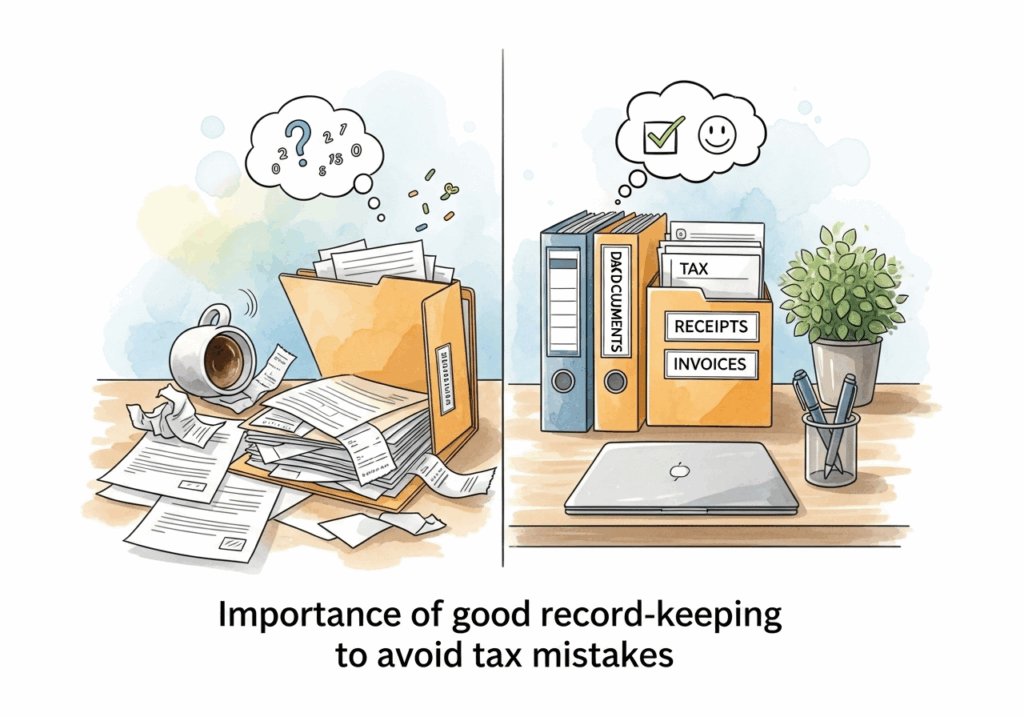
Why is Inadequate Record-Keeping and Supporting Documentation a Problem?
This is perhaps the most fundamental and pervasive mistake. Without meticulous record-keeping, everything else crumbles.
- Lack of Supporting Documents: Not retaining original invoices, receipts, bank statements, or contracts to substantiate declared income and expenses.
- Poor Reconciliation: Inconsistent reconciliation between bank statements, accounting software, and tax returns.
- Mixing Business and Personal Finances: This is a common pitfall for smaller SMEs, making it nearly impossible to distinguish legitimate business expenses from personal ones.
- Outdated or Incomplete Records: Failing to keep records for the required five-year period, or records that are illegible or incomplete.
💬 Expert Insight:
“The cornerstone of good tax compliance is robust record-keeping. Without it, you can’t accurately prepare your returns, and more importantly, you can’t defend yourself during a SARS audit. It’s often the lack of documentation, rather than outright fraud, that lands businesses in hot water.” – Luan van Rhyn
What Are The Consequences: Penalties, Interest, and Legal Action from SARS?
Nobody wants to receive that dreaded letter from SARS. But understanding the potential ramifications of sars targeting companies tax mistakes is essential not to scare you, but to empower you to avoid them. The consequences can range from administrative headaches to severe financial and even criminal penalties.
What are Administrative Penalties: Fixed vs. Percentage-Based?
SARS is not shy about levying penalties. These fall broadly into two categories:
- Fixed Amount Administrative Penalties: These are typically imposed for non-compliance with administrative duties, such as late filing of tax returns (e.g., income tax, VAT, PAYE). The amount of the penalty depends on your taxable income and the number of months the return is outstanding. For companies, these can range from R250 to R16,000 per month for each month the non-compliance continues, depending on the assessed loss or taxable income in the preceding year.
- Percentage-Based Penalties (Understatement Penalties): These are far more severe. If SARS finds that you’ve understated your tax liability, they can impose a penalty calculated as a percentage of the understated tax. The percentage varies significantly based on the “behaviour” that led to the understatement:
- Substantial Understatement (no reasonable explanation): 25%
- Reasonable Grounds for Adjustment (without disclosure): 50%
- Gross Negligence: 100%
- Intentional Tax Evasion/Fraud: 150% – 200% (or even higher for repeat offenders)
How Do We Understand Interest Charges on Unpaid Tax?
Beyond penalties, SARS also charges interest on underpaid or unpaid tax. This interest is calculated daily from the due date of the payment until the date it is settled. The interest rate is typically linked to the prevailing prime lending rate, making it a significant additional cost, especially for long-standing debts. It accrues regardless of whether the underpayment was intentional or accidental.
When Do Tax Mistakes Become Criminal Offences?
This is where “mistakes” cross the line into “crimes.” While an honest error or oversight might result in penalties and interest, deliberate actions to avoid tax can lead to criminal prosecution. Examples include:
- Fraudulent Activity: Intentionally providing false information, forging documents, or creating fictitious expenses to reduce tax liability.
- Tax Evasion: Wilfully and unlawfully failing to pay tax due by concealing income, making false claims, or manipulating records.
- Failure to Register for Tax: Deliberately avoiding registration when legally required.
- Failure to Submit Returns: Repeated and deliberate failure to submit required tax returns.
Conviction for tax offences can result in substantial fines, imprisonment, or both. SARS is increasingly taking a tougher stance on criminal tax non-compliance, aiming to send a clear message.
✅ Key Takeaway: The severity of the consequence depends heavily on the ‘behaviour’ that led to the mistake. Honest errors are handled differently from gross negligence or outright fraud. Transparency and cooperation are key if you find yourself under scrutiny.
Here’s a simplified overview of some common SARS penalties for businesses:
| Type of Non-Compliance | Trigger Event | Penalty Type & Range | Additional Charges | Notes |
|---|---|---|---|---|
| Late Filing (ITR14, VAT201, EMP201) | Missing statutory submission deadlines | Fixed Amount Penalty: R250 – R16,000 per month of non-compliance (based on taxable income/loss). | Interest on unpaid tax | Applies even if tax due is R0 or if you’re due a refund. |
| Understatement of Tax | Taxable amount declared is less than due | Percentage-Based Penalty: 25% to 200% of the understatement (based on behaviour). | Interest on unpaid tax | Behaviour assessed (e.g., substantial understatement, gross negligence, intentional tax evasion). |
| Late Payment of Tax Due | Failure to pay tax by due date | 10% Penalty on the amount of tax unpaid. | Interest on unpaid tax | Applies to Income Tax, VAT, PAYE, Provisional Tax. |
| Non-Registration for Tax | Operating without required registration | Administrative penalties; potential criminal charges. | Interest | Can lead to significant back taxes and severe penalties once discovered. |
| Non-Compliance with Audit Request | Failing to provide requested documents or information | Penalties for hindering SARS’s duties; potential for estimated assessments or criminal charges. | Cooperation is crucial during an audit. |
How Do SMEs Navigate a SARS Audit?
Receiving a SARS audit notification can feel like a punch to the gut. But take a deep breath. While it’s serious, it’s not necessarily a death sentence for your business. Many audits are routine, and knowing the process and your rights can significantly ease the burden and lead to a positive outcome. The key here is preparedness and understanding what SARS is looking for when sars targeting companies tax mistakes.
What is the Audit Notification Process?
A SARS audit typically begins with a formal notification, usually via eFiling, email, or registered post. This letter will:
- Inform you of the audit: Clearly state that your business has been selected for an audit.
- Specify the tax periods and types of tax: It won’t be a fishing expedition. The notification will outline precisely which tax years and which specific taxes (e.g., VAT, Income Tax, PAYE) are under scrutiny.
- Request specific information and documents: This is where the rubber meets the road. SARS will provide a list of documents they require, such as financial statements, general ledgers, invoices, bank statements, and contracts.
- Provide deadlines: Crucially, it will stipulate the deadlines for submitting the requested information. Ignoring these deadlines can lead to further penalties or even an estimated assessment.
💡 Pro Tip: Do not panic, and do not ignore the notification. Engage with it immediately. If you need more time to gather documents, communicate promptly with SARS to request an extension, providing a valid reason.
How Do We Prepare for a SARS Audit: Key Documentation?
This is where your meticulous record-keeping truly shines. If you’ve been diligent, preparation will be significantly smoother.
- Gather All Requested Documents: Methodically collect every single document SARS has asked for. Organise them logically by type and period.
- Reconcile Your Books: Ensure your financial records (e.g., general ledger, trial balance) reconcile with your submitted tax returns. Look for any discrepancies before SARS does.
- Understand Your Declarations: Review the tax returns for the periods under audit. Understand how each line item was calculated and what documentation supports it.
- Prepare Explanations for Variances: If there are significant fluctuations in income or expenses from previous years, or unusual transactions, have a clear, concise explanation ready, supported by evidence.
- Consult Your Tax Practitioner: Before you submit anything, have your tax advisor review all documents and your strategy. Their expertise can be invaluable in identifying potential issues and ensuring you present your case effectively.
What Are Your Rights and Responsibilities During the Audit?
You have rights, but also clear responsibilities, during a SARS audit:
- Right to Privacy: SARS officials generally cannot enter your premises without your permission or a warrant. Most audits are conducted by correspondence.
- Right to Explanations: You have the right to understand why certain information is requested and the basis for any assessments or proposed adjustments.
- Right to Representation: You have the absolute right to be represented by a tax practitioner, accountant, or legal counsel throughout the audit process. It’s highly advisable to exercise this right.
- Right to Object: If you disagree with a SARS assessment, you have the right to object and appeal (more on this later).
- Responsibility to Cooperate: You are legally obliged to provide true and accurate information requested by SARS within the stipulated deadlines. Failing to do so can lead to further penalties.
- Responsibility to Keep Records: Maintain all relevant records for the prescribed five-year period.
Navigating a SARS audit requires a calm, methodical approach. It’s a process, not a confrontation, provided you are compliant and cooperative.
What Proactive Measures Can You Take: Avoiding Tax Mistakes Before They Happen?
Let’s shift gears from reacting to being proactive. In the world of tax, prevention is always better than cure. By implementing smart strategies and fostering a culture of compliance within your business, you can significantly reduce the risk of sars targeting companies tax mistakes and free yourself from unnecessary stress.
How Can You Implement Robust Financial Record-Keeping Systems?
This is non-negotiable. Strong record-keeping is the bedrock of good tax compliance.
- Invest in Accounting Software: Ditch the spreadsheets (unless you’re a whiz with them and rigorous about backup). Cloud-based accounting software (e.g., Xero, Sage, QuickBooks) automates much of the data entry, reconciliation, and reporting, reducing human error.
- Digitalise Documents: Scan and store all invoices, receipts, and supporting documents digitally. Cloud storage ensures easy access and backup.
- Separate Business and Personal Finances: This cannot be stressed enough. Open a separate business bank account and use it exclusively for business transactions. Avoid co-mingling funds.
- Categorise Expenses Meticulously: Ensure every transaction is correctly categorised. This makes financial reporting and tax return preparation much simpler and more accurate.
- Regular Reconciliation: Reconcile your bank statements with your accounting records frequently (ideally monthly). This helps catch discrepancies early.
💡 Pro Tip: Implement a “no receipt, no claim” policy within your business. Empower your team to understand the importance of keeping every piece of supporting documentation for business expenses.
Why is Regular Review of Tax Compliance Processes Important?
Tax compliance isn’t a “set it and forget it” task. It requires ongoing attention.
- Monthly/Quarterly Check-ins: Schedule regular reviews of your payroll, VAT, and provisional tax calculations. Are there any new hires? Have any VAT rules changed for your industry?
- Internal Control Procedures: Implement internal checks and balances. For example, have a second person review payroll before submission, or a senior staff member cross-check VAT returns.
- Annual Tax Health Check: Before year-end tax filing, conduct a thorough tax health check with your accountant. This proactive review can identify and correct errors before they become issues with SARS.
- Understand Your Industry Benchmarks: While not absolute, having an idea of typical expense ratios or profit margins for your industry can help you identify if your figures are significantly out of line, potentially drawing SARS’s attention.
How Do You Stay Informed on Changes in Tax Legislation?
Tax laws in South Africa are dynamic. What was true last year might not be today.
- Subscribe to SARS Communications: Sign up for SARS newsletters and alerts via their eFiling portal.
- Follow Reputable Tax News Outlets: Subscribe to tax updates from leading accounting firms, tax consultancies, or business news sites in South Africa.
- Engage with Tax Professionals: Your tax practitioner should be your first line of defence. They are obligated to stay updated on legislative changes and advise you accordingly.
- Attend Webinars/Seminars: Many professional bodies and firms offer free or paid webinars on recent tax changes relevant to SMEs.
Staying informed isn’t just about avoiding penalties; it’s about leveraging legitimate tax benefits and planning effectively for your business’s future.
How Do We Correct Errors: The SARS ‘Request for Correction’ and Voluntary Disclosure Programme (VDP)?
Okay, so despite your best efforts, a mistake has slipped through. It happens! The good news is that SARS provides mechanisms to correct errors, and in some cases, even encourages voluntary disclosure of past non-compliance. Knowing how to use these tools can significantly mitigate the fallout from sars targeting companies tax mistakes.
What is the ‘Request for Correction’ Process Explained?
If you’ve identified an error on a submitted tax return (e.g., your annual income tax return or a VAT return), SARS allows you to submit a ‘Request for Correction’ (ITR14 or VAT201 as amended, etc.).
- Eligibility: This is generally for honest mistakes or omissions that are not deliberate attempts to evade tax. It’s for rectifying errors on returns that have already been assessed by SARS.
- Process:
- Identify the Error: Pinpoint the specific mistake(s) and the affected tax period(s).
- Gather Supporting Documents: Collect all necessary documentation to substantiate the correction.
- Initiate on eFiling: Log into your eFiling profile. Navigate to the relevant tax type and period. You’ll typically find an option to “Request a Correction” or “Amend Return.”
- Make the Changes: Amend the incorrect fields on the electronic return.
- Submit: Submit the revised return.
- SARS Review: SARS will review the correction, potentially request additional information, and issue a revised assessment.
- Timelines: Generally, you can request a correction within certain periods (e.g., up to 5 years from the date of the assessment for income tax). However, it’s always best to correct errors as soon as they are discovered.
What are the Benefits and Eligibility for the Voluntary Disclosure Programme (VDP)?
The VDP is a powerful tool designed for taxpayers who have deliberately or inadvertently failed to comply with their tax obligations and wish to come clean. It’s an incentive-based programme aimed at encouraging compliance.
- Benefits:
- Reduced Penalties: Significant reduction or waiver of understatement penalties (often to 0% for non-intentional omissions).
- Immunity from Criminal Prosecution: This is a major draw. For issues disclosed through VDP, SARS grants immunity from criminal prosecution for the tax offences disclosed.
- No Fixed Amount Penalties: Fixed administrative penalties may also be waived or significantly reduced.
- Eligibility:
- Must Be Voluntary: The disclosure must be initiated by you before SARS has notified you of an audit or investigation into the specific non-compliance being disclosed.
- Must Be True and Complete: The disclosure must be comprehensive and honest.
- Must Involve Tax Due: There must be an understatement of tax (i.e., tax was due but not paid).
- Must Not be Subject to Current Audit: If SARS is already auditing the specific non-compliance you wish to disclose, it generally won’t qualify for VDP.
- Process: The VDP application is a formal process, often complex, requiring detailed calculations and explanations. It is highly recommended to engage a tax professional for a VDP application.
What is a Step-by-Step Guide to Amending Tax Returns?
For minor corrections on returns already filed via eFiling, the process is quite streamlined:
- Log in to eFiling: Go to the SARS eFiling website and log in to your business profile.
- Select Tax Type and Period: Navigate to “Returns,” then select the specific tax type (e.g., Income Tax, VAT, PAYE) and the relevant period.
- Choose “Request for Correction”: Click on the option to request a correction or amend the return. This will open the previously submitted return.
- Edit Fields: Make the necessary changes to the incorrect fields.
- Provide Reason for Correction (if prompted): SARS may ask for a brief reason for the amendment.
- Save and Submit: Save the changes and submit the corrected return.
- Monitor Status: Keep an eye on your eFiling correspondence for the revised assessment.
How Do We Dispute a SARS Assessment: Objections and Appeals?
What happens if SARS issues an assessment or penalty that you believe is incorrect or unfair? You don’t just have to accept it. The Tax Administration Act (TAA) provides clear mechanisms for disputing SARS assessments. This is a crucial aspect of your rights when SARS targeting companies tax mistakes.
What are the Grounds for Objection: When and How to Lodge?
If you disagree with an assessment issued by SARS, your first step is to lodge an objection.
- Grounds for Objection: You must have valid reasons. This isn’t about simply not liking the outcome. Common grounds include:
- Factual errors in the assessment (e.g., SARS used incorrect figures).
- Misinterpretation or misapplication of tax law by SARS.
- Failure by SARS to consider all relevant information submitted.
- Incorrect application of penalties.
- How to Lodge:
- Form ADR1: The formal objection is lodged on a “Notice of Objection” form (ADR1). This form requires you to state clearly the grounds for your objection, providing detailed reasons and referring to relevant sections of tax legislation if applicable.
- Supporting Documents: Attach any new or previously submitted documents that support your objection.
- Submission: The ADR1 form is typically submitted via eFiling.
- Key Timelines: This is critical! You generally have 30 business days from the date of the assessment to lodge an objection. There are provisions for late objections, but SARS requires a compelling reason and may not grant it.
What is the Appeal Process: Alternative Dispute Resolution (ADR) and Tax Court?
If your objection is disallowed by SARS, you have further avenues for appeal.
- Alternative Dispute Resolution (ADR): This is an informal, confidential process facilitated by an independent SARS ADR mediator. It’s often quicker and less costly than going to Tax Court. The goal is to reach a mutually agreeable settlement.
- How it works: If your objection is disallowed, SARS will issue a “Notice of Disallowance.” You can then request that the dispute be referred to ADR.
- Benefits: Reduces legal costs, preserves relationships, and offers a less adversarial environment.
- Tax Court: If ADR fails or is not opted for, the dispute can be escalated to the Tax Court.
- Nature: This is a formal court process, presided over by a judge, and operates similarly to other courts. It can be lengthy and expensive.
- Representation: You will almost certainly require legal representation (tax attorneys or advocates).
- Decision: The Tax Court’s decision is binding, though further appeals to higher courts (e.g., High Court) are possible on points of law.
What are Key Timelines and Requirements for Disputes?
Strict adherence to deadlines is paramount in tax disputes. Missing a deadline can result in you losing your right to appeal.
- Objection: 30 business days from assessment date (ADR1).
- Appeal (if objection disallowed): 30 business days from the date of the Notice of Disallowance (ADR2 – Notice of Appeal).
- Further Appeals: Strict timelines apply if appealing Tax Court decisions.
⭐ Key Insight: Don’t be intimidated. While tax disputes can be daunting, understanding the process and adhering to timelines, ideally with professional assistance, ensures you exercise your rights fully.
What is the Role of Tax Professionals in Ensuring Compliance and Mitigating Risk?
Navigating the complexities of South African tax law is a full-time job – one you, as a business owner, probably don’t have time for. This is precisely why tax professionals exist. Their role in helping SMEs comply and mitigate the risks associated with sars targeting companies tax mistakes cannot be overstated.
When Should You Engage a Tax Practitioner or Accountant?
It’s tempting to try and handle everything yourself, especially when you’re a small operation. But there are crucial junctures when professional help isn’t just a luxury, it’s a necessity:
- Starting a Business: To ensure correct registration for all relevant taxes (Income Tax, VAT, PAYE) from day one and establish proper accounting systems.
- Complex Transactions: When engaging in mergers, acquisitions, significant asset sales, or international transactions.
- Growth and Expansion: As your business grows, so does the complexity of your tax obligations.
- Audit Notification: As discussed, getting a professional involved immediately upon receiving an audit notification is highly advisable.
- Disputes with SARS: For objections, appeals, or VDP applications, professional representation is almost essential.
- Regular Compliance: For ongoing monthly/annual submissions, especially for businesses with fluctuating income or employee numbers.
- Lack of Internal Expertise: If you or your team lack in-depth tax knowledge.
What are the Benefits of Professional Tax Advisory for SMEs?
Engaging a tax professional offers a multitude of benefits that far outweigh the cost:
- Expert Knowledge: They are up-to-date with the latest tax legislation, interpretation notes, and SARS practices.
- Accuracy and Compliance: Minimise errors in tax calculations and submissions, significantly reducing the risk of penalties.
- Risk Mitigation: Proactively identify potential compliance risks and help implement strategies to avoid them.
- Time Savings: Free up your valuable time to focus on your core business operations.
- Strategic Tax Planning: Identify legitimate opportunities to optimise your tax position within the law.
- Representation: Act as your authorised representative in all dealings with SARS, including audits and disputes. This can significantly reduce stress and improve communication.
- Peace of Mind: Knowing your tax affairs are in capable hands allows you to focus on growth.
💬 Expert Insight:
“Many SMEs view tax compliance as a necessary evil, rather than a strategic business function. A good tax professional isn’t just about ticking boxes; they are an invaluable strategic partner who can help your business thrive by ensuring compliance and identifying legitimate tax efficiencies.”
How Do You Choose the Right Tax Professional in South Africa?
Choosing the right partner is crucial. Here’s what to look for:
- Professional Accreditation: Ensure they are registered with a recognised professional body like SAICA (South African Institute of Chartered Accountants), SAIPA (South African Institute of Professional Accountants), or are a registered Tax Practitioner with SARS. This ensures adherence to ethical standards and ongoing professional development.
- Experience with SMEs: Look for a professional with proven experience working with businesses of your size and in your industry.
- References and Reputation: Ask for client references or check online reviews.
- Communication Style: Choose someone who communicates clearly, explains complex tax issues in an understandable way, and is responsive to your queries.
- Technology Savvy: Ensure they are comfortable with eFiling and modern accounting software.
- Fee Structure: Understand their fee structure upfront to avoid surprises.
Investing in a good tax professional is an investment in your business’s future resilience against the challenges of SARS targeting companies tax mistakes. It’s about building a robust financial foundation for sustainable growth.
Frequently Asked Questions
Q: What is the penalty for late PAYE submission in South Africa? A: For late PAYE (EMP201) submissions, SARS typically levies a fixed amount administrative penalty. The specific amount depends on your company’s taxable income or assessed loss in the preceding year, ranging from R250 to R16,000 per month for each month the return remains outstanding.
Q: Can SARS audit my business for more than one tax year? A: Yes, SARS can audit your business for multiple tax years. The Tax Administration Act (TAA) generally allows SARS to go back five years for assessments where no fraud or misrepresentation is involved. If fraud, misrepresentation, or gross negligence is suspected, SARS can go back even further.
Q: What happens if I can’t afford to pay my outstanding tax to SARS? A: If you genuinely cannot afford to pay your tax debt, you can apply to SARS for a “Payment Arrangement” or “Offer of Compromise.” This allows you to pay your debt in instalments or, in severe cases, settle for a lesser amount. SARS will assess your financial situation thoroughly before granting such an arrangement. It’s crucial to engage with SARS proactively rather than avoiding them.
